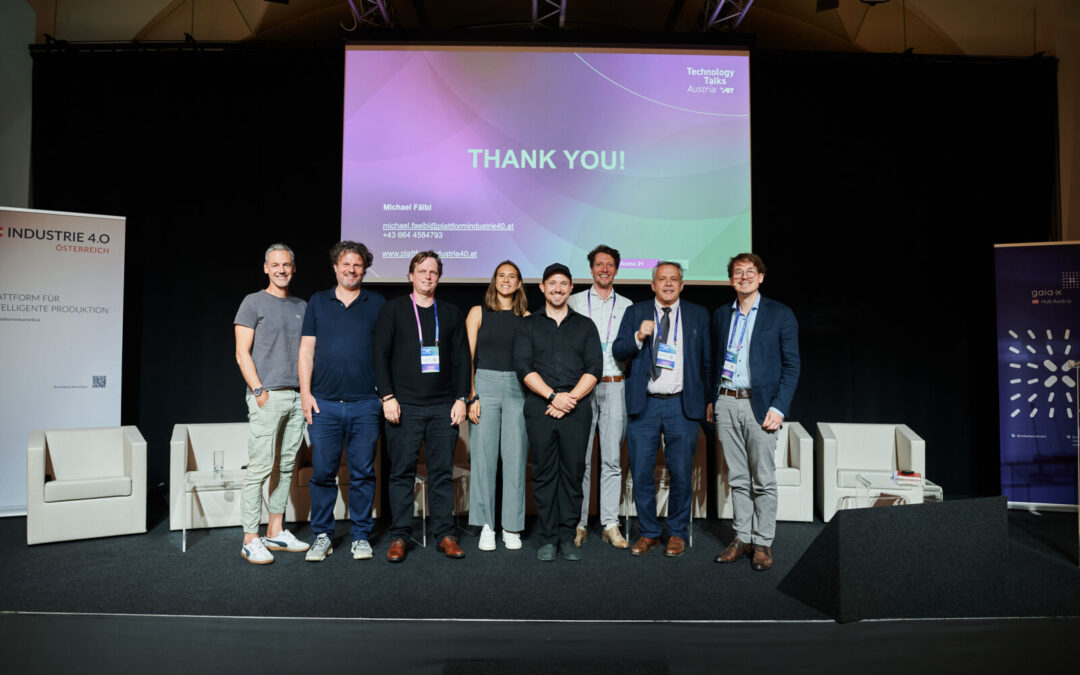
Panel discussion on the challenges and opportunities for scaling up data driven businesses in Central Europe
Tech Sovereignty is a central European goal. The whole continent – the EU, individual states and regions – invests heavily in building digital infrastructure like AI Factories, Data Spaces, Gaia-X, Open Source etc. Those and further initiatives should support the European economy in becoming more sovereign and globally competitive.
Spin-offs, startups and scaleups play a crucial role for enabling Europe’s digital future. To be successful, they must develop digital products that fit the market and fulfill European expectations at the same time. How do existing companies deal with this challenge? How can digital business success in Europe look like? And what can (future) spin-offs and startups learn from their experience?
About the event ‘Towards Sovereign Business Success’
This Special Event held in September 2025 aimed to answer those questions and get to know the people pushing European innovation.
- Roland Sommer, Plattform Industrie 4.0
- Michael Wiesmüller, BMIMI
- Stefan Plank, TACEO
- Martin Kaltenboeck, Graphwise / Semantic Web Company
- Andreas Krimbacher, nexyo
- Benjamin Mörzinger, nista
- Markus Sabadello, Danube Tech GmbH
- Alexander Wahler, Onlim
- Hannah Wundsam, AustrianStartups
- Moderation: Michael Fälbl, Platform Industry 4.0 Austria
Europe’s digital future is a key issue in politics, business, and society. As part of Technology Talks Austria 2025, this question was examined from different perspectives in a special event entitled ‘Towards Sovereign Business Success’.
The workshop brought together leading voices from startups, industry, research, and politics.
Michael Fälbl from Platform Industry 4.0 focused on the question: How can Europe achieve digital sovereignty while successfully bringing innovative business models to market?
Spin-offs and startups as drivers
Particular attention was paid to the role of spin-offs, startups, and scaleups. They are considered the engine of Europe’s digital competitiveness – provided that innovative technologies can be reconciled with marketable products and European values.
“We need the geeks who build technology and want to be global leaders in niche areas,” demanded Stefan Plank (Co-Founder & COO, TACEO). In doing so, he summed up the need for technological pioneering spirit.
Hannah Wundsam (Managing Director, AustrianStartups), on the other hand, warned that startups in Europe need better access to capital: “More European venture capital is crucial to give young companies long-term prospects.”
From idea to market
The question of how innovations make it onto the market was also a focus. Benjamin Mörzinger (CEO and founder, nista) reminded us that technologies are only successful if they are understandable and immediately usable for users:
“Facebook was able to build reach and acceptance very quickly through applications such as Farmville-it succeeded in entering the market through a clear, understandable point of use. We need similar applications for the data economy.
However, in the DACH region in particular, we often get lost in technical details and infrastructure issues. This results in high-performance systems, but there is a lack of users because the direct added value is not visible enough.”
Standardization as the key
Markus Sabadello (founder, Danube Tech GmbH) highlighted a key point: “Those who build standards shape markets.” Standardization was emphasized not only as a technical necessity, but also as a strategic tool for European competitiveness.
Andreas Krimbacher (Technical Lead, nexyo) also underscored the importance of joint development processes: Only when companies are actively involved in research projects can practical and implementable solutions emerge.
Political and technological decisions
From a political perspective, Michael Wiesmüller (Head of Department: Digital and Key Technologies for Industrial Innovation, BMIMI) presented the perspective of the Federal Ministry: “The market penetration of technologies and the sustainable use of data spaces have been core elements of Austria’s innovation strategy for almost 10 years and will also play an important role in the upcoming key technology offensive.”
Alexander Wahler (CEO & Co-Founder, Onlim) illustrated the technological possibilities: He showed how data spaces can be linked to artificial intelligence – such as knowledge graphs or chatbots – and what market potential this creates, especially for German-speaking countries.
Semantic AI and structural challenges
Martin Kaltenböck (Co-Founder & SVP Customer Success, Graphwise / Managing Partner & CFO, Semantic Web Company), who was unable to attend due to scheduling conflicts, contributed his expertise in written form. He emphasized the relevance of semantic AI, which can help European companies make their AI investments trustworthy and scalable.
At the same time, he pointed out structural hurdles such as excessive regulation and the difficulty of financing intangible assets in Austria.
Collaboration as a success factor
The workshop impressively demonstrated that European digital sovereignty is not an abstract goal, but a concrete field of action. It requires courageous founders who drive new technologies forward, smart financing mechanisms that enable innovation, practical research that ensures transfer to the market, and clear, internationally compatible standards.
Only through close cooperation between politics, industry, startups, and research can data rooms, artificial intelligence, and open source be sustainably anchored in Europe as key technologies.
Helmut Leopold, Chairman of Gaia-X Hub Austria: “Combining our data from a wide range of industries and market sectors with intelligent methods for fair market mechanisms while maintaining complete control over our data is the basis for success in the future data and AI economy.”
Roland Sommer, Managing Director of Plattform Industrie 4.0: “Austrian startups and scaleups are in leading positions, even by international standards, and can make a significant contribution to Austrian and European technological sovereignty.”
Digital sovereignty is therefore not just a vision, but can become a European model for success with the right interaction between the various players.

The panel discussion facilitated the discussion among scaleups and gave them the floor due to their crucial role in shaping European technological sovereignty. The session provided clear insights for participants, especially policy makers from all over Europe who participated in the Technology Talks.
Author: Michael Fälbl, Plattform Industrie 4.0 Österreich
Get connected
More information: Denise Branz denise.branz@plattformindustrie40.at